Skip to content
Market Insights

Term deposit rates are falling: Where now for income investors?

Borrowers received the first glimmer of much-wanted relief when the Reserve Bank cut the Official Cash Rate (OCR) by 0.25% to 5.25% at their meeting on 14th August1.

The RBNZ had earlier noted2 that its estimate of the long-term neutral OCR was 2.75%, so the August cut appears to be the start of a much-needed easing cycle likely to run through to late 2025 or early 2026.

This outlook for a cut of 2.75% from the highs of the past year is great news for borrowers but may require a change of strategy for savers.

Prior to the announcement, bank term deposits were offering rates of over 6% p.a. for a one-year term – providing income investors with ready access to steady returns. Since the RBNZ announcement, these rates have already dropped, with the mainstream banks now offering 5.2% p.a for those same one-year term deposits. Craigs Investment Partners estimate that if the OCR continues to drop in line with forecasts, term deposit rates could dip to around 4.5% p.a within a year, and below 4% p.a. within two years. This would mean a dramatic 35-40% fall in bank deposit income.

So where can investors now look to access opportunities for income returns above 6% p.a?

As interest rates fall, investments in land-based assets can become more attractive and can benefit from two compounding factors. First, lower than anticipated interest costs can boost returns, and then over the longer-term, a lower cost of capital can lead to increasing property values.

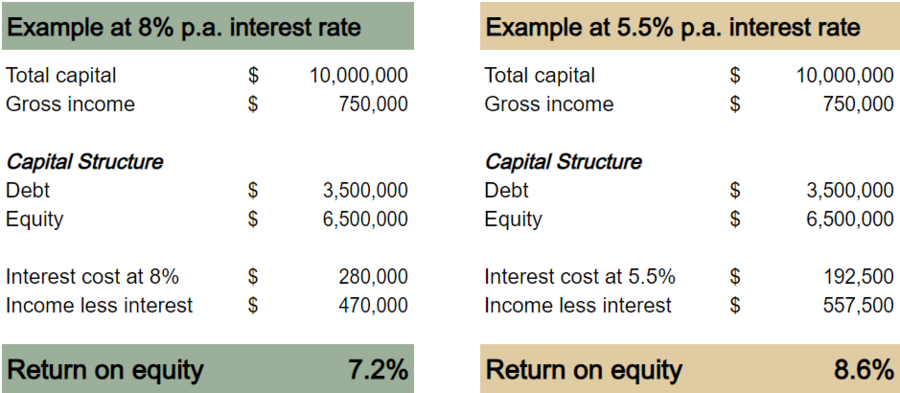
The below example illustrates the impact of falling interest rates on investor returns on a land-based asset. In this scenario, the asset is earning $750,000 of lease income each year and was purchased for $10,000,000. Of this capital, $3,500,000 is debt and $6,500,000 is investor equity.

You can see that at a mortgage interest rate of 8%, the annual cost of interest payments is $280,000 on the $3,500,000 of debt, giving a return of 7.2% p.a on the investors’ equity. As interest rates (and therefore mortgage interest costs) fall, investor returns increase – in the example, you can see returns on investor equity increase to 8.6% p.a at an interest rate of 5.5% p.a.
Picture2.png

Note that the model is aimed at showing the impact of interest costs and so it is simplified, with the only variable being interest costs.


1. Reserve Bank of New Zealand (August 2024), OCR 5.25% - Monetary restraint tempered as inflation converges on target

OCR 5.25% - Monetary restraint tempered as inflation converges on target - Reserve Bank of New Zealand - Te Pūtea Matua (rbnz.govt.nz)

2. Reserve Bank of New Zealand (May 2024), OCR 5.50% - Official Cash Rate to remain restrictive

OCR 5.50% - Official Cash Rate to remain restrictive - Reserve Bank of New Zealand - Te Pūtea Matua (rbnz.govt.nz)

Latest news & research

All News
Lower Rates, Higher Potential: The Rural Opportunity in 2026
26.01.2026

Lower Rates, Higher Potential: The Rural Opportunity in 2026

There are a range of investment opportunities available, each with their own set of risks and returns. Over the years, we have seen high investor interest in rural commercial property investments, particularly from investors looking for regular income.

As for all investments, returns from property can fluctuate over time as interest rates, market forces and other factors interact. In this article, we will discuss this investment cycle, what we have learnt from investing in this sector, and why MyFarm sees 2026 as an opportune time to consider an investment in rural commercial property.
Market Insights
Commercial Property 101: What Every Farmer Should Know
08.12.2025

Commercial Property 101: What Every Farmer Should Know

For many New Zealand farmers, the rhythm of income is dictated by the land – weather, commodity prices, and global demand all play their part. This means, as the agricultural sector continues to face future volatility, more farmers are looking beyond the paddock for ways to stabilise and diversify their financial returns. One avenue that’s gaining traction as interest rates fall is commercial property investment. But what does it really involve, and how can farmers make sense of the jargon and risks to make informed decisions?
Market Insights
Investment Diversification for Farmers - why act now?
24.11.2025

Investment Diversification for Farmers - why act now?

New Zealand farmers are no strangers to risk, with every season bringing its own set of challenges: milk payout swings, weather extremes, rising input costs, and regulatory changes, just to name a few. For decades, the strategy has been simple: own more land, milk more cows or run more cattle, and ride out the cycles. However, in the current climate, depending exclusively on dairy or sheep and beef farming leaves families vulnerable to broad, industry-wide risks that remain outside the control of even the most skilled producers.
Market Insights

Register your interest

Fill in your details and we’ll let you know about upcoming investment offers.

We will only use your contact details to provide information that you have requested. View our privacy policy here

Talk with one of our team:

Can I invest?

Subscribe for updates

Be informed about what’s happening in our primary sector.

Click the subscribe button below to receive the latest news and research, including sector and market updates from a local and global perspective.

We will only use your contact details to provide information you have requested. View our Privacy Policy

Investment Guide

Submit your details below to view a copy of our latest Investment Guide.

We will only use your contact details to provide information you have requested. View our Privacy Policy